
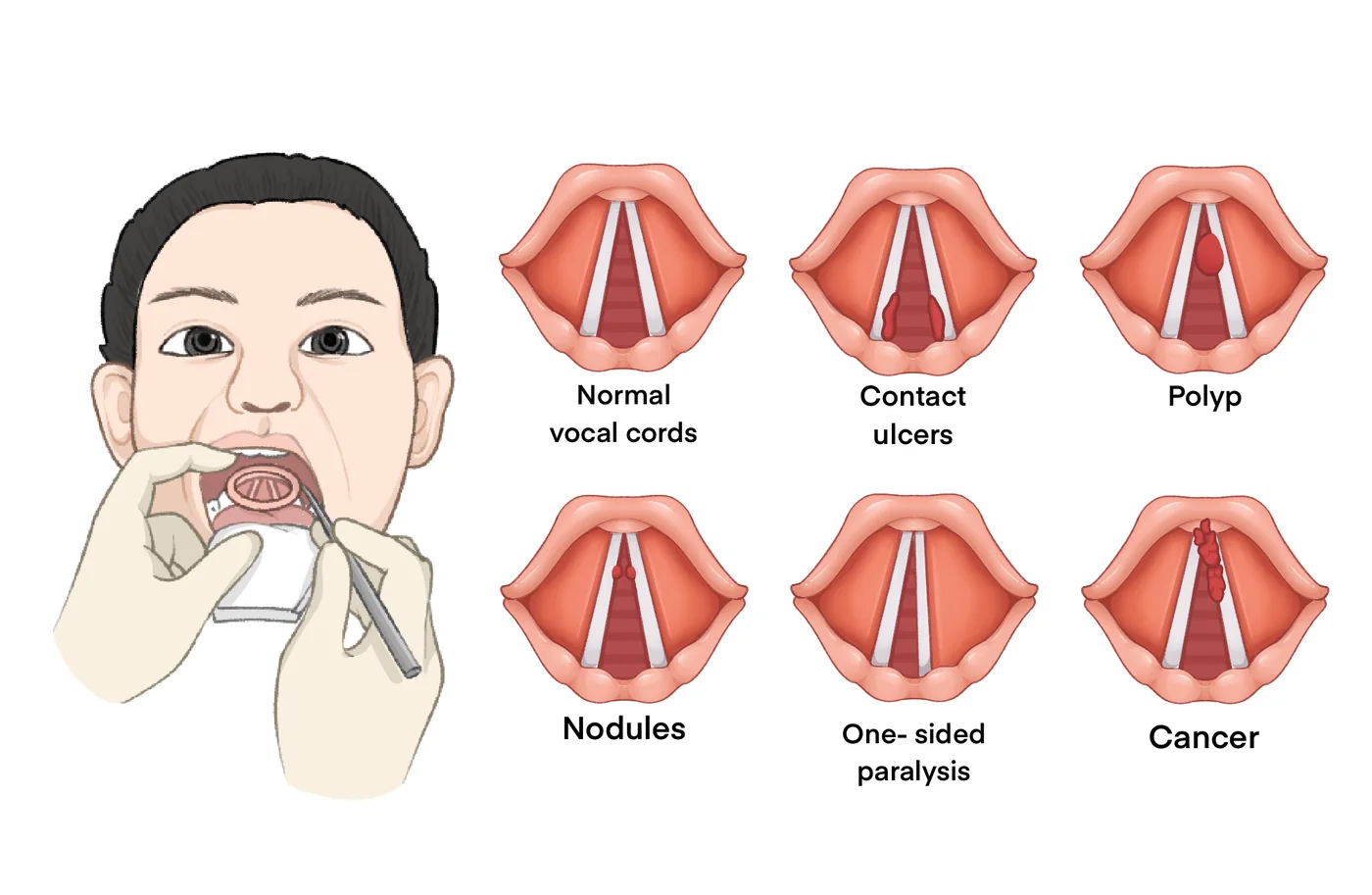
兩部分內容:其一爲聲帶狀態對照圖,以並置方式呈現正常聲帶與息肉、結節、單側麻痹等病變示意(圖內標註爲英文);其二爲約 5 秒的發聲主題靜音動畫。相關綜述討論器質性病變的聲學特徵與人工智能在嗓音研究中的應用,不代表本站提供診斷功能。
圖背後的故事
目的:良性或惡性器質性聲帶病變引起的嗓音障礙通常缺乏可靠的無創診斷工具,可能造成治療延誤。研究旨在識別具有區分能力的聲學標誌物,建立用於病變分類與惡性預測的機器學習模型;比較器質性聲帶病變患者中良性與惡性病例的發聲特徵,並評估模型區分健康與病理嗓音的潛力。方法:共納入 157 名參與者,包括 127 名器質性聲帶病變患者(109 例良性、18 例惡性)及 30 名健康對照。研究對元音進行聲學分析,評估聲帶振動參數,訓練 XGBoost、LightGBM 模型進行病變分類與惡性預測,並通過受試者工作特徵分析識別關鍵參數。結果:健康組與病變組之間有 63 項聲學參數差異具有統計學意義,偏度與峯度的區分能力尤其突出。六項參數(/u/skew、/i/skew、/o/kurt、/o/shapefactor、/o/impulsefactor、/a/peak2valley)對區分良惡性病變具有較高診斷價值。XGBoost 在聲帶病變分類中表現最佳,曲線下面積爲 0.735;LightGBM 在惡性預測中表現最佳,曲線下面積爲 0.924。年齡與特定聲學參數是模型中的顯著預測因素。結論:聲學分析結合機器學習可提高聲帶病變的診斷準確性,尤其有助於區分良性與惡性病例。研究顯示人工智能輔助嗓音分析有望成爲早期發現及臨牀決策的無創工具;仍需更大隊列驗證,以完善算法並支持更廣泛的臨牀應用。
論文摘要(中文譯文 · 原文)
中文譯文 摘要 目的 器質性聲帶病變(無論良性或惡性)所致嗓音障礙常缺乏可靠的無創診斷工具,可能導致治療延誤。本研究旨在識別有鑑別意義的聲學生物標誌物,並建立用於病變準確分類與惡性預測的機器學習模型:研究器質性聲帶病變患者嗓音產生的聲學特徵、比較良性與惡性病例,並評估機器學習模型區分健康與病理嗓音的診斷潛力。方法 共納入157名受試者,包括127名器質性聲帶病變患者(良性109例、惡性18例)與30名健康對照。對元音進行聲學分析,評估聲帶振動參數;訓練機器學習模型(極限梯度提升 XGBoost、輕量梯度提升機 LightGBM)對病變類型分類並預測惡性;以受試者工作特徵(ROC)分析確定關鍵診斷參數。結果 比較分析顯示健康組與病變組間有63項聲學參數差異具有統計學意義,其中偏度與峯度的鑑別力尤爲突出;六個關鍵參數(/u/偏度、/i/偏度、/o/峯度、/o/波形因子、/o/脈衝因子與/a/峯谷值)在區分良惡性病變中具有較高診斷價值。XGBoost 模型在聲帶病變分類中表現最佳(曲線下面積 AUC = 0.735),LightGBM 在惡性預測中表現突出(AUC = 0.924);年齡與特定聲學參數是模型中的重要預測因子。結論 聲學分析與機器學習的結合顯著提高了聲帶病變的診斷準確性,尤其在良惡性鑑別方面;這些發現凸顯了人工智能(AI)輔助嗓音分析作爲早期檢出與臨牀決策無創工具的潛力,仍需在更大規模人羣中進一步驗證,以完善預測算法、支持更廣的臨牀應用。關鍵詞:聲帶病變;聲學分析;客觀評估;機器學習模型;嗓音障礙診斷
Abstract Objective Voice disorders resulting from organic vocal cord lesions, whether benign or malignant, often lack reliable non-invasive diagnostic tools, which can lead to delays in treatment. This study aims to identify distinctive acoustic biomarkers and develop machine learning models for accurate classification of these lesions and prediction of malignancy. We investigated the acoustic characteristics of voice production in patients with organic vocal cord lesions, comparing benign and malignant cases, and evaluated the diagnostic potential of machine learning models in distinguishing between healthy and pathological voices. Methods A total of 157 participants were enrolled, including 127 patients with organic vocal cord lesions (109 benign, 18 malignant) and 30 healthy controls. Acoustic analysis was performed on vowel sounds, assessing vocal fold vibration parameters. Machine learning models (eXtreme Gradient Boosting (XGBoost), Light Gradient-Boosting Machine (LightGBM)) were trained to classify lesion types and predict malignancy. Receiver operating characteristic analysis identified key diagnostic parameters. Results Comparative analysis revealed 63 statistically significant differences in acoustic parameters between healthy and lesion-affected groups, with skewness and kurtosis being particularly discriminative. Six key parameters (/u/skew, /i/skew, /o/kurt, /o/shapefactor, /o/impulsefactor, and /a/peak2valley) demonstrated high diagnostic value in distinguishing benign from malignant lesions. The XGBoost model achieved the best performance in classifying vocal cord lesions (area under the curve (AUC) = 0.735), while LightGBM excelled in malignancy prediction (AUC = 0.924). Age and specific acoustic parameters were significant predictors in the models. Conclusion The integration of acoustic analysis with machine learning significantly enhances the diagnostic accuracy for vocal cord lesions, particularly in differentiating between benign and malignant cases. These findings underscore the potential of artificial intelligence (AI)-assisted voice analysis as a non-invasive tool for early detection and clinical decision-making. Further validation in larger cohorts is necessary to refine predictive algorithms for broader clinical application. Keywords: Vocal cord lesions, acoustic analysis, objective evaluation, machine learning models, voice disorder diagnostics