

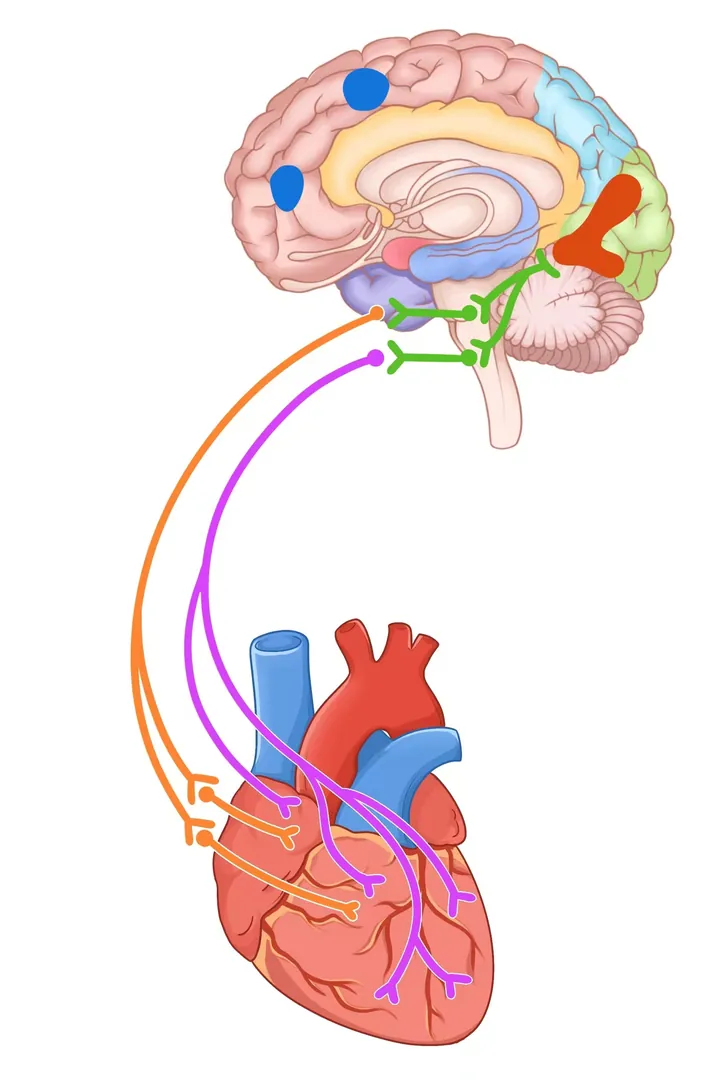
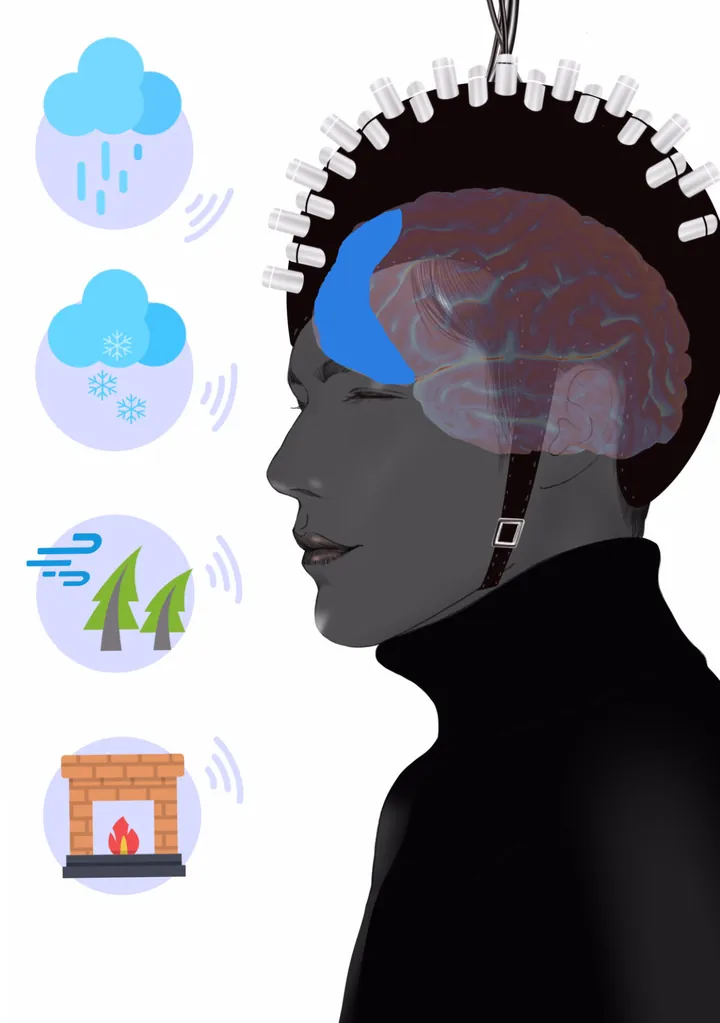
Wie sieht man Emotionen? Zwei Antworten: ein personifiziertes Hirn und Emotionen als Wetter — als Einstieg in psychische Gesundheit.
Die Geschichte hinter dem Bild
Publikationsbeleg
Figure 4 · derivative (redaktionelle Fassung derselben Vorlage)
Sedative Effect of White Noise on Prefrontal Cortex Lobe: A Randomized Controlled Study Based on Functional Near-Infrared Spectroscopy
Abstract (Originalfassung)
Background: White noise has attracted widespread attention due to its potential effects on psychological and physiological states, particularly in promoting relaxation. The prefrontal cortex, a critical region of the brain responsible for higher cognitive functions and emotional regulation, may influence an individual's mental and physical health through its responses to external stimuli. Although previous research has investigated the calming effects of white noise, systematic studies on its specific impact on prefrontal cortex activity are still lacking. This study aims to explore the calming effects of white noise on the prefrontal cortex to elucidate its associated physiological mechanisms. Methods: In total, 103 healthy adult college students were recruited and randomly divided into four groups (fire, n = 24; wind, n = 27; rain, n = 27; and snow, n = 25), with each group exposed to the corresponding white noise for 3 min. Functional near-infrared spectroscopy (fNIRS) was used to evaluate excitability changes in the brain and changes in life signs and facial expressions were also measured. Results: The data of fNIRS were analyzed by paired sample t-test; in the wind group and the snow group, we found that the white noise can be effectively decreased the cortical excitability of related brain areas. The areas of reduced excitability were concentrated in the prefrontal cortex and pars triangularis of Broca's frontopolar area, while the concentration of oxyhemoglobin in these two area decreased from −0.159 to −0.107 µmol/L and from −0.139 to −0.096 µmol/L, respectively, both areas involved in relaxing and sedative modulation. Conclusion: White noise can reduce the excitability of the prefrontal cortex and play a sedative effect. It may strengthen our understanding of how white noise is involved in neural modulation.
Abgleich: F088 ist eine Variante derselben Arbeit; Figur, Hut und Wettersymbole stimmen, Stirnlappen-Färbung und Proportionen wurden geändert — siehe Figure 4.
doi.org/10.4103/nah.nah_88_24 · PubMed 40029675 · Volltext (PMC)
Zeichnung: Xiaofeng Jing (gemäß Author contributions); Rechte am Werk wurden am 2026-10-20 als Firmyeigentum bestätigt.
Lizenz CC BY-NC-SA 4.0 (Namensnennung, Share-Alike); Werksrechte als Firmeneigentum bestätigt 2026-10-20, Zeichnungskredit im Paper bei Xiaofeng Jing. Lizenz ansehen