

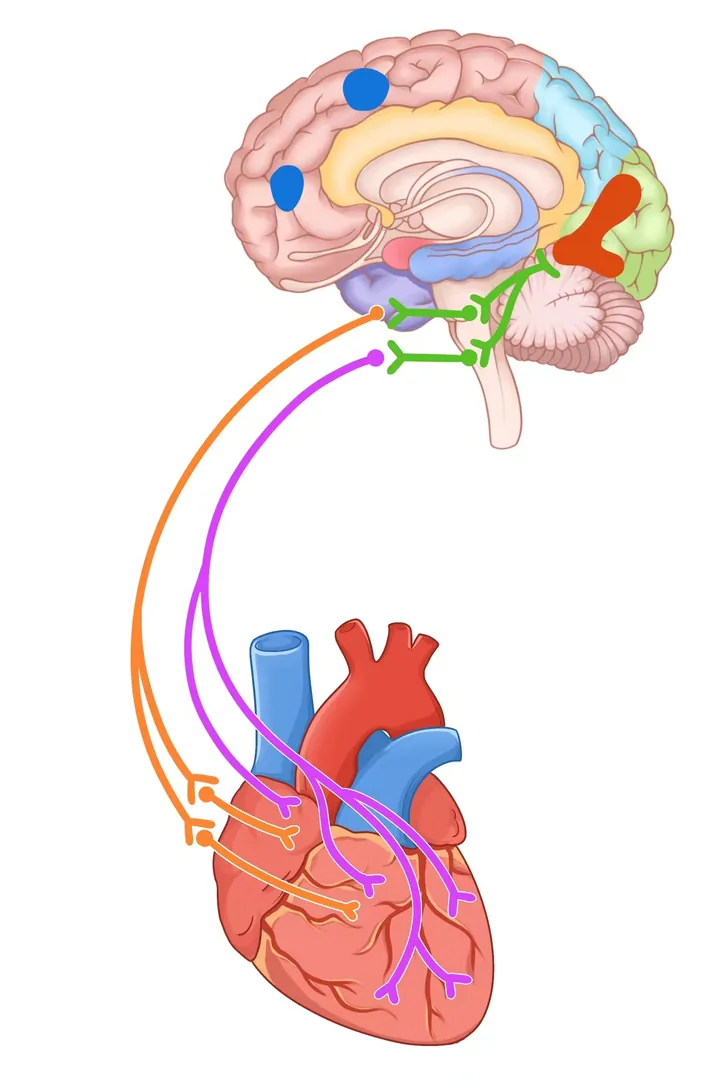
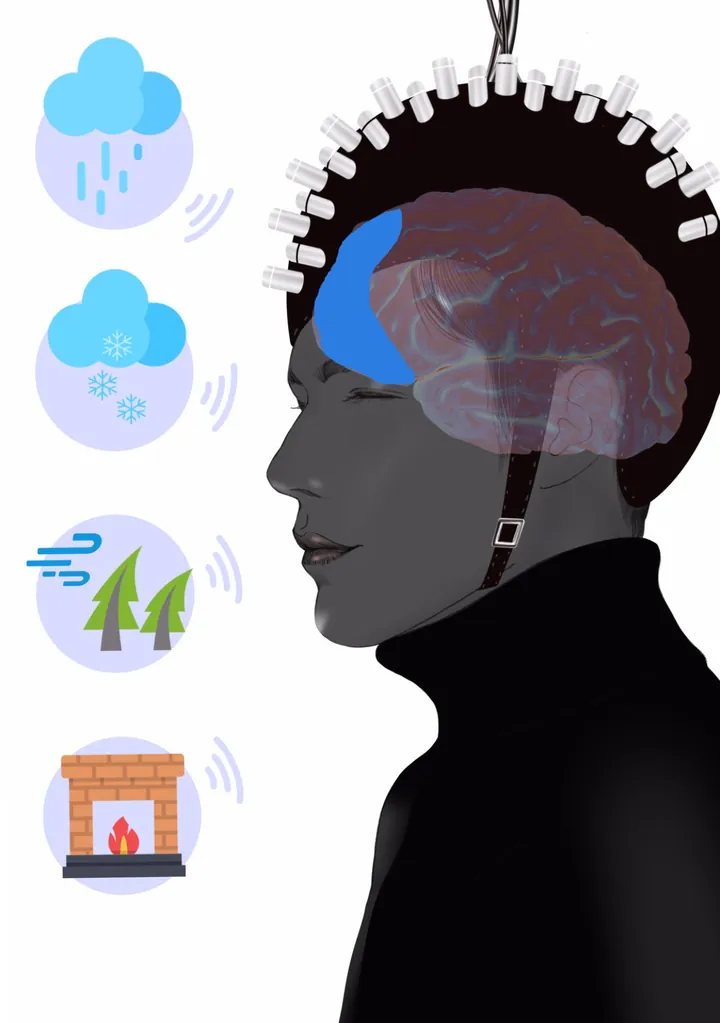
How do we see emotion? Two answers in one set: a personified brain under different emotional states, and emotion as weather — sun and rain icons shifting inside a head silhouette. Good openers for mental-health education.
The Story Behind the Image
Paper evidence
Figure 4 · derivative (paper-edited version of the same artwork)
Sedative Effect of White Noise on Prefrontal Cortex Lobe: A Randomized Controlled Study Based on Functional Near-Infrared Spectroscopy
Article abstract (English original)
Background: White noise has attracted widespread attention due to its potential effects on psychological and physiological states, particularly in promoting relaxation. The prefrontal cortex, a critical region of the brain responsible for higher cognitive functions and emotional regulation, may influence an individual's mental and physical health through its responses to external stimuli. Although previous research has investigated the calming effects of white noise, systematic studies on its specific impact on prefrontal cortex activity are still lacking. This study aims to explore the calming effects of white noise on the prefrontal cortex to elucidate its associated physiological mechanisms. Methods: In total, 103 healthy adult college students were recruited and randomly divided into four groups (fire, n = 24; wind, n = 27; rain, n = 27; and snow, n = 25), with each group exposed to the corresponding white noise for 3 min. Functional near-infrared spectroscopy (fNIRS) was used to evaluate excitability changes in the brain and changes in life signs and facial expressions were also measured. Results: The data of fNIRS were analyzed by paired sample t-test; in the wind group and the snow group, we found that the white noise can be effectively decreased the cortical excitability of related brain areas. The areas of reduced excitability were concentrated in the prefrontal cortex and pars triangularis of Broca's frontopolar area, while the concentration of oxyhemoglobin in these two area decreased from −0.159 to −0.107 µmol/L and from −0.139 to −0.096 µmol/L, respectively, both areas involved in relaxing and sedative modulation. Conclusion: White noise can reduce the excitability of the prefrontal cortex and play a sedative effect. It may strengthen our understanding of how white noise is involved in neural modulation.
Matching note: F088 (emotion & brain illustration) is a variant of the same work; figure, hat and the rain/snow/wind/fire icons match, with changes to the frontal shading and proportions — see Figure 4.
doi.org/10.4103/nah.nah_88_24 · PubMed 40029675 · Full text (PMC)
Drawing: Xiaofeng Jing (per the paper's Author contributions); rights confirmed as company-owned by the company principal on 2026-10-20.
Licence: CC BY-NC-SA 4.0 (third-party reuse of the paper version requires attribution and share-alike). Work rights: the company principal confirmed on 2026-10-20 that this work is company-created, with no licensing risk for the website; the paper version's drawing credit goes to Xiaofeng Jing. view license