
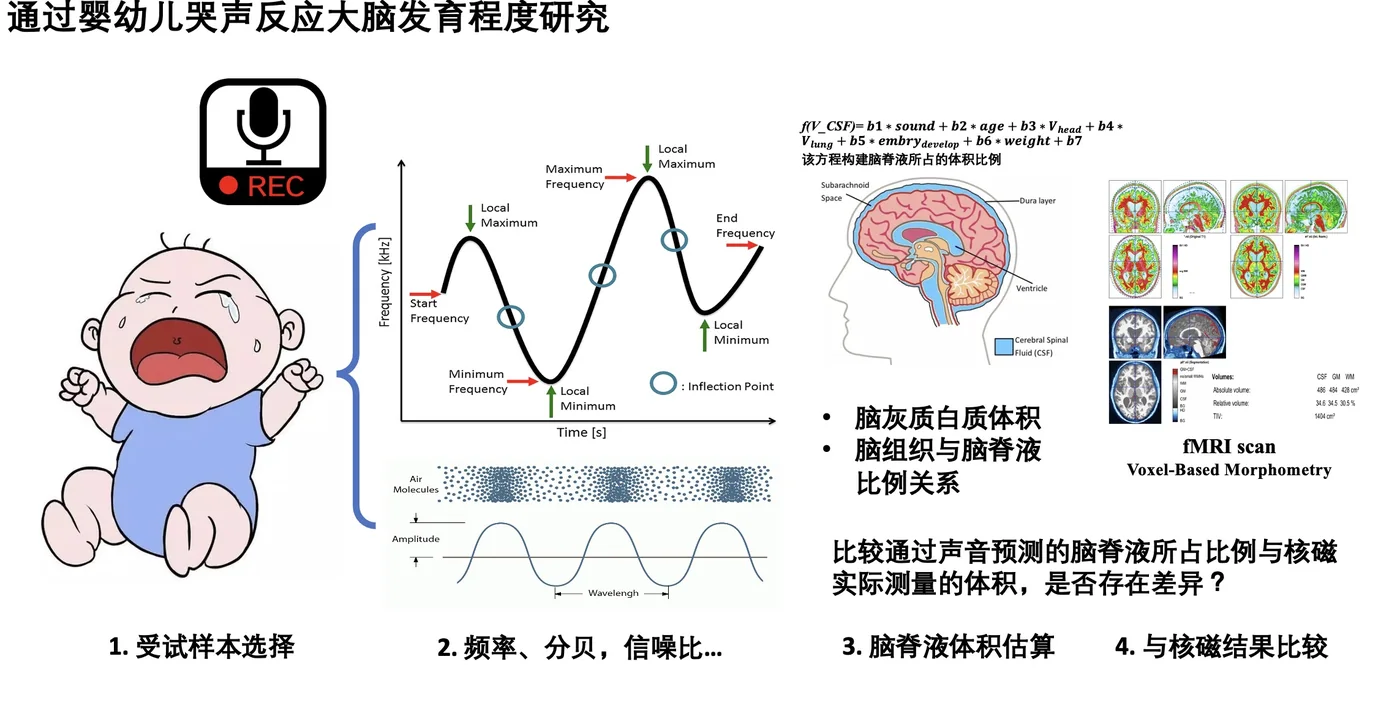
流程图呈现一项研究方案的设想:提取婴儿哭声的声学特征,与脑影像(MRI)指标对照分析。动画以约 3 秒的静音循环重现“哭声—分析—对照”的路径。团队已发表婴儿哭声自动分割方法学论文,以及一篇以婴儿哭声为主题的叙述性综述。
图背后的故事
婴儿哭声包含丰富的神经生理、病理及心理信息,但哭声与脑结构之间的关系仍不清楚。研究纳入 154 名早产儿与 84 名足月儿,在相似刺激条件下录制 1 分钟哭声,使用 MATLAB 分析声音数据。统计时将同一婴儿的重复哭声观测取平均,每名婴儿对每项声学参数贡献一个数值。43 名早产儿接受磁共振成像,以测量灰质、白质和脑脊液体积。早产儿的哭声周期与吸气时长较足月儿更长(P 分别为 0.022、0.014);早产儿不同胎龄组的哭声参数无显著差异(均 P>0.05)。在接受 MRI 的 43 名早产儿中,不同胎龄组的灰质、白质体积及其与脑脊液的比值存在显著差异。哭声参数与脑体积的相关性总体较弱。多元线性回归显示,哭声参数与白质体积相关(R²=0.38,P=0.039),与灰质或脑脊液体积无显著关联。本研究发现不同胎龄婴儿的哭声特征与 MRI 脑体积指标之间存在关联;虽然哭声特征可能反映某些脑发育信息,但关联总体较弱,应视为探索性结果。
论文摘要(中文译文 · 原文)
中文译文 婴儿啼哭传递丰富信息,涉及神经生理、病理与心理等多个方面。然而,啼哭与脑结构之间的关系仍知之甚少。本研究纳入154名早产儿与84名足月儿,在相近刺激条件下各录制1分钟哭声;使用 MATLAB 软件分析哭声数据,统计上对同一婴儿的多次哭声水平观测取平均值,每名婴儿的每个哭声声学参数贡献一个数值。对43名早产儿行磁共振成像(MRI),测量灰质、白质与脑脊液(CSF)体积。早产儿的哭声周期与吸气时长长于足月儿(P = 0.022、0.014);早产儿内部各胎龄组的哭声参数差异无统计学意义(均P > 0.05)。在43名行 MRI 的早产儿中,灰质与白质体积在不同胎龄组间差异显著(P = 0.01、0.02),灰质/脑脊液与白质/脑脊液比值亦然(P = 0.010、0.020)。哭声参数与脑体积的相关总体较弱。多元线性回归显示,哭声参数与白质体积相关(R² = 0.38,P = 0.039),与灰质或脑脊液体积无关。本研究识别了不同胎龄婴儿哭声特征与 MRI 脑体积之间的关联;这些发现提示哭声特征可能反映脑发育的某些方面,但观察到的关联总体较弱,应视为探索性结果。
Infant crying conveys abundant information, including neurophysiological, pathological, and psychological aspects. However, the relationship between crying and brain structure remains poorly understood. In this study, 154 preterm infants and 84 term infants were enrolled, and their cries were recorded for 1 min under similar stimulation conditions. MATLAB software was used to analyse the crying data, for statistical analyses, repeated cry-level observations were averaged within infant, and each infant contributed one value for each cry acoustic parameter. Magnetic resonance imaging (MRI) was performed in 43 preterm infants to measure the volumes of grey matter, white matter, and cerebrospinal fluid (CSF). Preterm infants had longer cry cycle and inhale durations than term infants (P = 0.022 and 0.014). Among preterm infants, cry parameters did not differ significantly across gestational ages (all P > 0.05). In 43 preterm infants with MRI, grey and white matter volumes differed significantly across gestational age groups (P = 0.01 and 0.02), as did the grey matter/CSF and white matter/CSF ratios (P = 0.010 and 0.020). Correlations between cry parameters and brain volumes were generally weak. Multiple linear regression showed that cry parameters were associated with white matter volume (R2 = 0.38, P = 0.039) but not with grey matter or CSF volume. This study identified associations between cry characteristics and MRI-derived brain volumes in infants across gestational ages. Although these findings suggest that cry characteristics may reflect certain aspects of brain development, the observed associations were generally weak and should be considered exploratory.